Document Exchange
Commercial documents are exchanged centrally via networks such as Peppol, direct API and SFTP connections, and existing email channels. This creates a single, controlled process for all invoice flows.

Automate the exchange of invoices, orders, and other business documents between organizations and systems.
Commercial documents are exchanged centrally via networks such as Peppol, direct API and SFTP connections, and existing email channels. This creates a single, controlled process for all invoice flows.
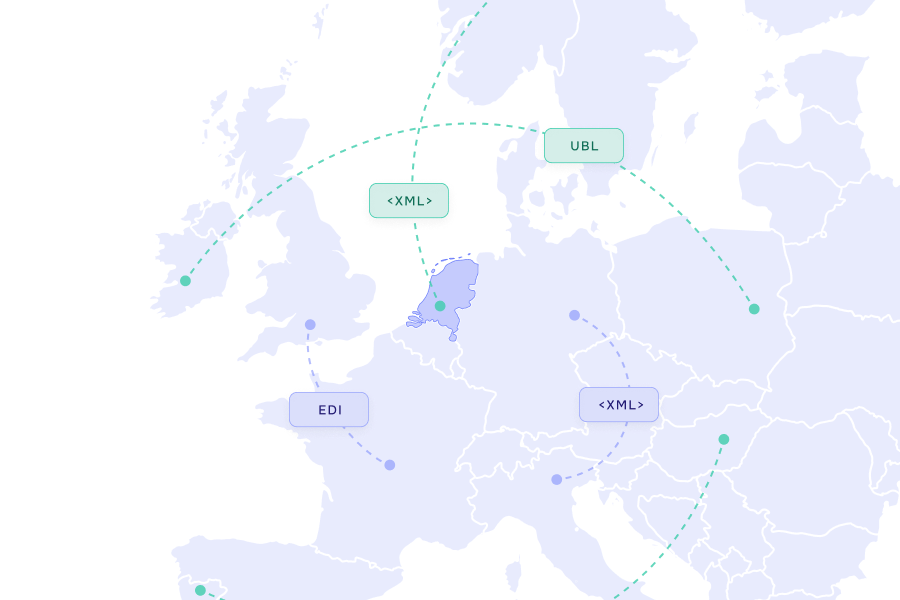
PDF and XML formats, such as UBL, UN/CEFACT CII, and cXML, are recognized and converted to a single agreed-upon XML standard. Documents are then automatically delivered in the format and via the channel specified by the receiving party.
Data is checked against established rules, master data, and ERP information. Missing, incorrect, or inconsistent data is flagged and, where possible, corrected.
Reliable e-transactions connect document exchange with purchase-to-pay and order-to-cash. Issues are identified earlier, making financial processes faster and more predictable.
Commercial documents are exchanged centrally via networks such as Peppol, direct API and SFTP connections, and existing email channels. This creates a single, controlled process for all invoice flows.
PDF and XML formats, such as UBL, UN/CEFACT CII, and cXML, are recognized and converted to a single agreed-upon XML standard. Documents are then automatically delivered in the format and via the channel specified by the receiving party.
Data is checked against established rules, master data, and ERP information. Missing, incorrect, or inconsistent data is flagged and, where possible, corrected.
Reliable e-transactions connect document exchange with purchase-to-pay and order-to-cash. Issues are identified earlier, making financial processes faster and more predictable.
Email exchanges require human intervention. With e-transactions, you can exchange invoices and other business documents quickly and securely between systems.
A single platform that connects various channels and systems, including its own Peppol Access Point. Formats are standardized, data is validated, and invoices are delivered in a format ready for processing.
Peppol is an international network for e-transactions. Through a single access point, such as 4CEE, you can exchange invoices and trade documents with organizations that are also connected to Peppol or affiliated networks.
Webinar | 7 oktober
Webinar | October 7 – Practical AI applications for Accounts Payable and Accounts Receivable: from invoice processing to cash application.
International legislation regarding invoices is constantly evolving. Compliant document exchange requires both technical and legal expertise.
Whereas tax authorities have traditionally audited transactions after the fact, audits are increasingly taking place at the time of the transaction and for each invoice individually.
Through ViDA, the EU is modernizing the VAT rules governing intra-EU B2B transactions via e-invoicing and digital reporting. At the same time, an increasing number of member states are also implementing these requirements at the national level.
4CEE Exchange connects organizations and systems for document exchange.
Direct exchange is possible, for example, via an API connection. However, you would then need to make separate arrangements with each supplier or customer regarding the connection, format, security, and management. Through a transaction network, you connect once and can then reach an ever-increasing number of trading partners in a standardized and secure manner. This makes electronic document exchange more scalable and also provides a better foundation for future e-reporting requirements.
An e-transaction platform can bring together various channels and formats. For example, invoices received via email as PDFs can be recognized using OCR and converted into a structured XML format. At the same time, you can actively support and encourage suppliers and customers to switch to e-transactions on their own. This allows existing document exchange to continue, while the proportion of fully electronic transactions gradually increases.
Think of it like telecommunications: you don’t have to be on the same network as the person you’re calling. A connection with a single service provider is sufficient, because the underlying infrastructure and standards facilitate the exchange between connected parties. Within Peppol, the principle of“connect once, reach all”therefore applies : through a single certified Access Point provider, you can reach other connected organizations.
That varies by country. Governments may mandate their own models, platforms, formats, and reporting requirements, meaning that a single technical solution is not sufficient everywhere. However, connecting to an open, international network such as Peppol often provides a strong foundation to which additional country-specific connections can be linked. Therefore, choose a partner who not only provides the network connection but can also support the various national requirements, platforms, and future changes.
Office of the CFO solutions that bring E-transactions, Purchase to Pay, Order to Cash, and Financial Planning & Analysis into flow.