

What is ViDA? (VAT in the Digital Age)
The ViDA Act introduces new systems for digital reporting ande-invoicing, adapts VAT rules for the platform economy, and aims to implement a uniform VAT registration system for trade within the EU. Through these initiatives, VAT in the Digital Age promises a more streamlined, transparent, and fair VAT system in the digital age.
Why ViDA?
The European Commission launched VAT in the Digital Age with several objectives in mind, primarily focused on improving the existing VAT system within the European Union.
One of the primary objectives of the ViDA legislation is to prevent VAT fraud. This is a significant problem within the EU, resulting in the loss of billions of euros in VAT revenue each year. The European Commission’s 2022 VAT Gap Report shows that the VAT gap amounted to a staggering 93 billion euros in 2020. The VAT gap is the difference between expected VAT revenue and the VAT actually collected.
A major cause of this VAT gap is fraud: according to the report, as much as 25% of the lost VAT revenue is attributable to this. That means that in 2022, VAT fraud in the European Union amounted to approximately 23 billion euros. With “VAT in the Digital Age,” the Commission aims to implement a more robust and transparent system that can effectively tackle this fraud.
To achieve this, ViDA is introducing what are known as digital reporting requirements. These require businesses to report invoice data to tax authorities in near real time, immediately after the taxable event occurs. As a result, businesses will no longer need to file quarterly VAT returns in the future; the data will be continuously monitored at the transaction and invoice level. These so-called continuous transaction controls (CTC) make VAT fraud virtually impossible, as tax authorities gain faster insight into who is claiming what.
Furthermore, increasing the effectiveness of the VAT system is a key component of ViDA. The current system has been in place for decades and is not optimized for today’s digital economy. The digitization of compliance is therefore a key aspect of ViDA. This includes facilitating e-invoicing and real-time digital reporting, making it easier for businesses to meet their VAT obligations while simultaneously reducing administrative burdens.
In summary, the main goals of ViDA are:
- To make the VAT system more effective and fairer;
- To prevent VAT fraud;
- Ensuring the proper functioning of the internal market;
- Adapting the VAT system so that it responds to the new digital world;
- Digitizing compliance.
What will change with ViDA?
With the introduction of the ViDA Act, businesses in the European Union are facing significant changes to the VAT system. The measures proposed by the European Commission can be broadly divided into three pillars:
- Digital reporting and e-invoicing;
- Adapting VAT rules to the platform economy;
- Working toward a single VAT registration in the European Union.
Digital reporting and e-invoicing will become mandatory
Perhaps the most significant change for businesses resulting from this legislative initiative is the way companies send and receive invoices. E-invoicing will become mandatory for B2B transactions throughout Europe. Every e-invoice with a VAT component will soon have to be processed through the tax authorities, so that compliance with VAT obligations can be verified at the invoice level. This is known as Continuous Transaction Control.
Digital reporting is inextricably linked to the content and structure of an e-invoice. That is why ViDA requires that e-invoices comply with the European standard EN 16931, so that tax authorities in every member state can automatically interpret and verify the content. Only structured, validated data enables real-time reporting.
The goal is to reduce VAT fraud and lower administrative costs for businesses in the EU. For companies, this means they must adapt their systems to send and receive e-invoices and to comply with the new digital reporting requirements.
Platform companies will play a (greater) role in VAT collection
Another important change under ViDA is the revised VAT rules for the platform economy. These rules mean that operators of platforms for, for example, passenger transportation and short-term accommodations will be responsible for collecting and remitting VAT on behalf of their users. Platforms will therefore be more closely involved in VAT matters
This change is intended to ensure a uniform approach across all member states and to create a more level playing field between online and traditional providers.
A Single VAT Registration in the European Union
Finally, ViDA enables the introduction of a single VAT registration for businesses that sell to consumers in different EU countries. This reduces the need for multiple VAT registrations within the EU and simplifies VAT reporting for businesses. It will significantly reduce the administrative burden for businesses operating in multiple EU member states, and it will make it easier for new and smaller businesses to expand into markets in different EU countries.
What is already known about ViDA?
At this time, not all details of VAT in the Digital Age are known. For example, we know that we’ll eventually have to switch to e-invoicing, but we don’t yet know how to do that. Will it have to be done through a specific platform? Peppol, perhaps? Will companies be able to connect to it themselves, or will everyone need a service provider with a Peppol Access Point? These are questions the European Commission will need to answer in the coming months or years.
No Mandatory European Standard for E-Invoicing
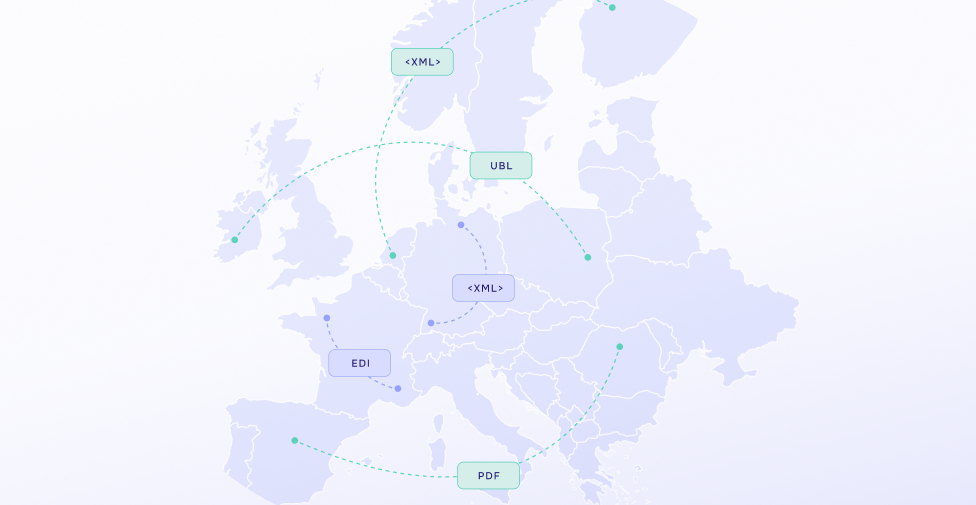
It is noteworthy that the European Commission will likely not mandate a single standard for all member states regarding e-invoicing. Countries that have already made e-invoicing mandatory and implemented CTC, or are currently in the process of doing so, will be allowed to continue with those systems. This has implications for companies and organizations that do business internationally.
Parties that send and receive invoices only within the Netherlands will—logically—have to comply with the new Dutch rules. However, parties with customers or suppliers in countries where e-invoicing is already mandatory must also comply with the rules of those countries. And those rules can be quite extensive, for example regarding technical specifications and mandatory data that must be included.
Companies with international operations must determine for themselves how to navigate this patchwork of rules and obligations. Ensuring compliance can therefore be quite challenging for companies operating internationally.
Latest Updates on ViDA
In May 2024, the European Commission published an updated version of the legislative proposal. The most significant changes relate to:
-
Postponement of implementation dates: Many of the original deadlines were postponed. For example, the introduction of the “deemed supplier” rules has been moved from January 1, 2025,to July 1, 2028 (optional) and January 1,2030 (mandatory). This gives member states and businesses more time to adapt to the new rules
-
Flexibility for Member States: In the updated version, Member States are given more leeway to decide whether or not to implement certain parts of the proposal. This applies in particular to the rules regarding e-invoicing and the obligation for platforms to collect and remit VAT.Starting January 1, 2025,Member States may introduce national e-invoicing requirements without prior approval from the European Commission, provided that the transactions are domestic.
-
Changes for platforms: The rules for platforms have been further refined. For example, Member States may now exclude small and medium-sized enterprises (SMEs) from the “platform fiction” rule. In addition, the maximum rental period for short-term rentals subject to the VAT obligation has been reduced from 45 to 30 days.
-
Phased Introduction of Digital Reporting Requirements (DRR) The requirement for digital reporting of B2B transactions will be introduced in phases.The first phase will take effect on July 1, 2030, for cross-border B2B transactions. Member States with existing national reporting systems have until January 1, 2035, to adapt their systems to European standards.
-
Exceptions for Micro-Enterprises Member States may choose to exempt these businesses from the e-invoicing and/or digital reporting requirements. This measure is intended to limit the administrative burden on the smallest businesses.
-
Mandatory technical standards clarified The European Commission has confirmed that electronic invoices must comply with EN 16931.Member States must use interoperable networks such as Peppol or an equivalent alternative that meets European specifications.
Updates following the vote in the fall of 2024
- Political agreement reached (November 2024): During the ECOFIN Council meeting onNovember 5, 2024, the member states finally reached a political agreement on the ViDA package. This paved the way for formal approval of the proposal.
- Formal adoption of ViDA (March 2025): The ViDA package was formally adopted onMarch 11, 2025, and published in the Official Journal of the EU onMarch 25, 2025. The measures will be implemented in phases between 2025 and 2035.
- Introduction of DRR and e-invoicing: As of July 1, 2030, e-invoicing will be mandatory for cross-border B2B transactions within the EU. However, Member States may introduce national e-invoicing requirements as early as 2025 without needing prior approval from the European Commission.
- Deemed supplier rules for platforms: The obligation for platform operators to collect and remit VAT on short-term rentals and passenger transport takes effect onJanuary 1, 2030. Member States may introduce this obligation as early as July 1, 2028. Small sellers may be exempt from this obligation.
- Expansion of the OSS system (VAT registration): Starting July 1, 2028, the One-Stop Shop (OSS) will be expanded. This simplifies cross-border e-commerce and eliminates the need for multiple VAT registrations. Certain supplies, such as call-off stock and energy products, will be included in the OSS.
- Harmonization of national DRR systems:Member states that were already using digital reporting systems before 2024 must adaptthem to the new European DRR standardsby January 1, 2035, at the latest .
- New EU data platform: Central VIES 2.0: A revamped VIES (VAT Information Exchange System) will be introduced, bringing together real-time VAT transaction data from all Member States. Among other things, this platform will integrate e-invoicing, e-reporting, and OSS data and strengthen cooperation between tax authorities.
Additional updates following final approval in March 2025
- High Approval Rating in the European Parliament: On February 12, 2025, the European Parliament once again approved the ViDA package by a large majority of 623 votes in favor, 26 against, and 28 abstentions. This paved the way for final approval.
- No further votes or legislative changes after March 2025: Following formal approval by the Council on March 11, 2025, there have been no additional legislative votes or amendments. Since then, the focus has been on technical implementation, guidelines for member states, and preparation for the national rollout of e-invoicing and DRR.
Preparing for ViDA
Experts are already warning that the ViDA legislative proposal will have just as much impact on businesses as the introduction of the euro in 2002. It is therefore wise to prepare thoroughly and in a timely manner. And by “in a timely manner,” we actually mean: now. Each country is moving at its own pace with e-invoicing, and in many EU member states, the new requirements will take effect even before ViDA’s expected implementation date. If you do business in a country that’s implementing the rules sooner, you’ll need to adapt your processes accordingly.
In any case, you already know that VAT in the Digital Age is on its way. So start by gaining a thorough understanding of what ViDA entails. Familiarize yourself with the new requirements for digital reporting and e-invoicing, revised VAT rules for the platform economy, and the introduction of a single VAT registration. What do the new rules entail?What are the potential risks? And what are the implications for compliance?
Next, it’s wise to take a close look at your current (IT) systems and processes. What will be needed to receive and send e-invoices in the future? For example, in terms of infrastructure and master data? Consider partnering with an external provider specializing in areas such as e-invoicing, compliance, and digital transformation. They can provide valuable insights and support as you prepare for these changes.