

Overview
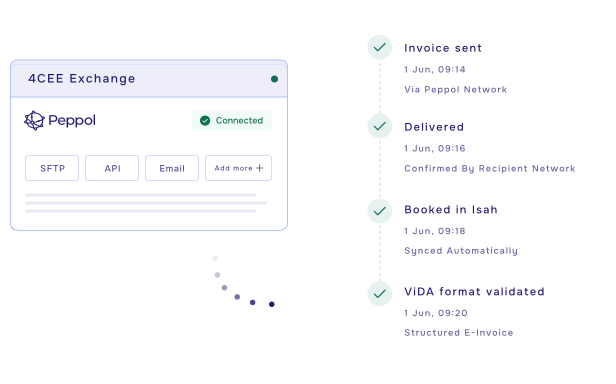
4CEE Exchange connects organizations, systems, and networks for the digital exchange of trade documents. As such, 4CEE Exchange serves as the central hub for reliable, scalable, and compliant document exchange.
Customers, suppliers, and logistics partners use different ERP systems, document formats, and exchange channels. This leads to manual processes, errors, delays, and compliance risks. 4CEE Exchange eliminates this complexity by centrally organizing and automating document exchange.
4CEE Exchange acts as a central hub for the exchange of trade documents. The platform receives documents from various sources, enriches and validates the content, converts documents to a different format if necessary, and delivers them via the desired channel or network.
| Supported Documents | Supported channels | Supported formats |
|---|---|---|
|
|
|
Benefits
Whether an invoice or purchase order comes from an email message, an API integration, or an SFTP connection, 4CEE Exchange ensures that the document is exchanged with customers, suppliers, and other business partners:
- Speed: Documents arrive at the recipient in a machine-readable format immediately, without anyone having to retrieve them from an email inbox and process them manually.
- Quality: Data (in XML) can be automatically validated for accuracy and completeness, rather than requiring manual verification of a PDF or scan.
- Security: Trading partners who also use e-transaction networks are verified and authenticated, reducing the risk of fraud and invoice manipulation.
- Compliance: Meets future requirements such as ViDA (VAT in the Digital Age), which mandates structured e-invoicing and real-time reporting within the EU.
Functionality
4CEE Exchange offers an integrated set of processing functionalities for receiving, processing, transforming, and exchanging trade documents. These functionalities form the basis for automated document exchange.
The underlying architecture is based on modern cloud technology and container platforms such as Kubernetes, providing organizations with a scalable and future-proof solution for document exchange.
Connectivity
4CEE Exchange offers connectivity to various business exchange networks. This allows organizations to connect to the preferred channels of customers, suppliers, and other trading partners without having to implement a separate solution for each network. Examples:
- API Connectivity
- SFTP connectivity
- Email connectivity
- Peppol Access Point
- Partner and B2B Networks
Format conversion
Business partners do not always use the same document standards. That is why 4CEE Exchange supports the automatic conversion of documents between different representations, standards, and file formats. Examples:
Mapping between standards and formats
In addition to technical conversion, 4CEE Exchange also supports document mapping. This involves translating data from one format into the structure and meaning of another format or system. This allows organizations to exchange information without requiring all involved systems to use the same standard. Examples:
- Mapping to customer- or supplier-specific formats
- Translations between document standards
- Integrations with ERP and business applications
Validation of documents and message flows
Before documents are processed or delivered, 4CEE Exchange checks whether they comply with the required standards, business rules, and network specifications. This ensures that errors are detected early, reducing the risk of rejections or processing issues. Examples:
- Checking for required document fields
- Validation against document standards
- Checking message structures
- Network-specific checks, such as for Peppol
Enrichment of document data
Documents do not always contain all the information needed for further processing. 4CEE Exchange can supplement or enrich document data based on available business rules, configurations, and additional data sources. Examples:
- Filling in missing data
- Adding identifiers and references
- Harmonizing document content across systems
Routing to the correct channel or network
After a document is processed, 4CEE Exchange automatically determines which channel or network should be used to deliver the document. This allows a single document flow to support multiple delivery methods without requiring additional integrations. Examples:
- Sending via Peppol
- Delivery via API integrations
- Exchange via email
- Integration via SFTP
- Delivery via partner networks
Peppol Access Point
The 4CEE Peppol Access Point provides direct access to the Peppol network for the exchange of electronic trade documents. From within 4CEE Exchange, documents can be securely and in a standardized manner sent to and received from customers, suppliers, and government organizations connected to Peppol. Gateway describes the Access Point as the component for sending and receiving Peppol messages via AS4.
Within 4CEE Exchange, the Peppol Access Point supports, among other things:
- Sending and receiving electronic documents via Peppol
- SML/SMP lookups for recipient detection
- Validation against Peppol standards
- Routing to the correct recipient
- Monitoring of delivery statuses
| 4CEE Exchange | 4CEE Peppol Access Point |
|---|---|
| Document exchange platform | Connectivity to the Peppol network |
| Supports multiple channels and networks | Specifically supports Peppol |
| Validation, enrichment, conversion, and routing | Sending and receiving Peppol messages |
| Invoices, orders, order confirmations, packing slips, and more | Peppol communication within those document flows |
The 4CEE Peppol Access Point is part of 4CEE Exchange.
Use cases
Exchanging invoices via Peppol and other networks
Send and receive electronic invoices via Peppol, email, APIs, or SFTP from a single central platform. 4CEE Exchange handles validation, format conversion, and delivery via the appropriate channel or network.
Connecting business partners who use different systems
Not every customer or supplier uses the same standards, ERP systems, or networks. 4CEE Exchange translates documents between formats and systems, enabling digital information exchange without the need for custom solutions for each trading partner.
Converting PDF documents to structured data
Convert PDF documents into structured data for further processing in ERP and business applications, or generate a readable PDF from an XML document. This reduces manual processing and error-prone data entry.
Preparing for e-invoicing and compliance requirements
More and more countries are imposing requirements for electronic document exchange and structured invoice data (ViDA). By validating, converting, and exchanging documents according to recognized standards, 4CEE Exchange helps organizations digitize and standardize their document flows.