

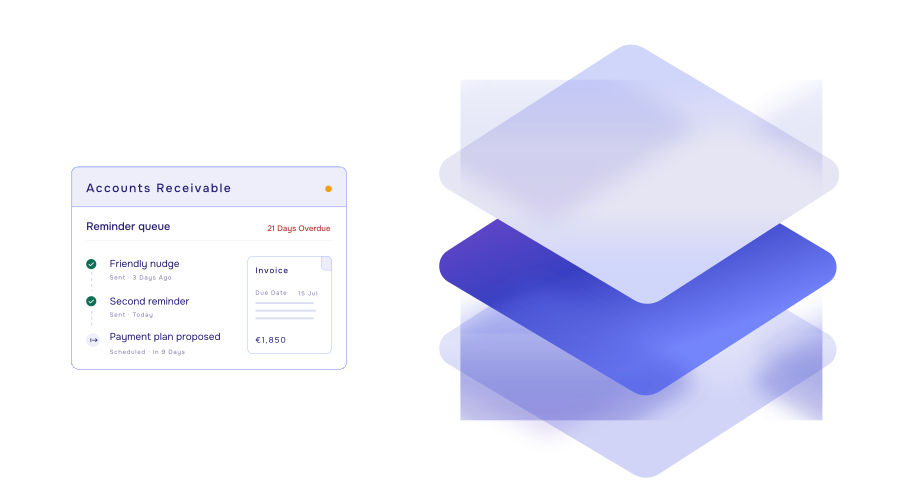
From Outstanding Invoice to Cash
Sending an invoice does not automatically mean payment has been received. Between those two moments lies a process that involves communication, customer behavior, payment options, and financial processing. It is precisely there that an unnecessary amount of manual work often arises.
Outstanding invoices are tracked manually, reminders are sent at set intervals, and payments must then be matched to the correct line items. Meanwhile, disputes may go unresolved, customers may have varying payment habits, and the Finance department may lack sufficient visibility into what action is actually needed.
A well-designed Collections & Payments system is therefore about more than just sending reminders faster. The goal is to track outstanding invoices in a targeted manner, make payments as easy as possible, and efficiently process received payments back into the accounting system.
Not every outstanding invoice requires the same approach
Traditional accounts receivable management often follows a relatively fixed schedule. An invoice reaches its due date, followed by a first reminder, then a second, and finally, possibly, a demand for payment.
That process is easy to organize, but it treats all customers as if they were the same.
In reality, payment behavior varies greatly. One customer consistently pays before the due date. Another always pays around day 35, despite a 30-day payment term. Yet another pays only after a reminder, while for a fourth customer, payment delays are primarily caused by disputes or internal administrative processes.
An effective collections strategy takes these differences into account.
Customer segmentation can be combined with factors such as outstanding balance, DSO, payment history, invoice age, and previous contact points. A small invoice from a customer who consistently pays on time may require a different follow-up than a large overdue balance from a customer whose payment behavior has recently deteriorated.
Collections thus becomes less of a generic reminder process and more of a targeted decision: which customer needs what action at what time?
Payment behavior is often more predictable than the due date
The contractual due date is important, but it does not necessarily indicate when a customer will actually pay.
For example, an organization may have hundreds of customers who are formally required to pay within 30 days, while some consistently pay around day 40. That behavior is undesirable, but it is predictable. This information is valuable for daily collections prioritization.
By taking historical payments into account, a more realistic picture of the expected payment date emerges. As a result, deviations are also noticed more quickly. If a customer who normally pays around day 28 has still not paid after 40 days, that can be a more significant signal than a customer who traditionally pays around day 45.
Payment behavior thus helps direct attention to where changes are occurring.
The same applies to communication. Some customers respond well to an automated reminder. Others request phone contact or personal follow-up. For large accounts, an account manager can play a key role, while standard customers can be followed up on entirely automatically.
The quality of collections therefore lies not in the number of reminders sent, but in the relevance of the chosen action.
An overdue invoice isn’t always a payment problem
An invoice may remain unpaid because a customer is unwilling or unable to pay. But just as often, there is another reason.
An order number is missing. The invoice was sent to the wrong department. According to the customer, the quantity delivered is incorrect. There is uncertainty regarding a rate or contractual agreement. Or a portion of the invoice is disputed.
In such cases, it makes little sense to send increasingly stern reminders. The underlying issue must first be resolved.
That is why dispute management is an integral part of collections.
As soon as a customer explains why an invoice isn’t being paid, that information must be documented and forwarded to the appropriate person in charge. Finance can usually handle a payment inquiry, but a discussion about pricing, delivery, or contract terms may require the involvement of Sales, Customer Service, or Operations.
Furthermore, recording disputes separately provides better insight into the structural causes of payment delays. When the same customers or invoice types consistently lead to questions, the solution may lie in the invoicing process rather than in collections.
In this way, collections becomes not only a means of pursuing payment but also a feedback mechanism for the broader Order-to-Cash process.
Make payment part of the communication
Reminding a customer that an invoice is outstanding is one step. Actually making payment easy is another.
In many B2B processes, a reminder still consists solely of a notification that an amount must be transferred, along with an invoice number and bank account information. The customer must then log into their online banking portal, enter the details, and initiate the payment.
Every extra step creates friction.
By including a payment link directly in a reminder, email, or customer portal, these steps can be streamlined. The customer can proceed directly to payment from the communication, with the invoice and payment information already linked.
For recurring payments, direct debit can take things a step further. If a valid authorization is in place, the customer does not have to initiate each individual payment anew. This can be particularly beneficial for subscriptions, periodic services, or other predictable billing flows.
The choice of payment method must, of course, align with the customer relationship and commercial agreements. However, the basic principle remains the same: the fewer actions required between the intention to pay and the actual payment, the lower the chance that an invoice will remain unpaid unnecessarily.
Collections doesn’t stop once the money is in the bank
For the customer, the process is complete as soon as the payment is made. For Finance, that’s not always the case.
A received payment must still be matched to the correct customer and outstanding invoice(s). That sounds simple when a single customer pays a single invoice in full and provides the correct invoice number. In practice, however, there are many exceptions.
A customer may combine multiple invoices into a single payment. An amount may differ due to a credit memo, discount, or withholding. A payment description may be incomplete. A payment may come from a different legal entity within the same group. Or a customer may pay only a portion of the outstanding invoice.
When these payments must be sorted out manually, the work simply shifts from collections to cash application.
Automatic matching therefore attempts to link received payments to outstanding items based on available data, such as invoice numbers, amounts, customer information, and payment references. Only when a reliable match cannot be made does an employee need to manually review the payment.
This follows the same principle as earlier in the process: automatically process standard cases and specifically address exceptions.
Fast processing makes the data more reliable
Accurate matching is not just a matter of administrative efficiency. It also determines the quality of the information used to guide collections efforts.
If a customer paid yesterday but the payment has not yet been linked to the outstanding invoice, that invoice still appears administratively overdue. As a result, the same customer may wrongly receive a reminder today.
This is not only inefficient but can also damage the customer relationship.
Rapid payment processing ensures that outstanding items reflect the actual situation as closely as possible. As soon as a payment has been reliably matched, the relevant item can be closed, and further follow-up ceases.
In this way, payment matching provides the feedback that closes the collections cycle.
Automate the routine, not every customer interaction
Collections is, by its very nature, a process in which automation can eliminate a great deal of repetitive work. That does not mean human communication disappears.
Standard reminders, payment confirmations, offering payment options, and prioritizing cases can largely be handled automatically. This actually creates more room for the cases where personal contact adds value.
An important customer with a large outstanding balance and a complex dispute may require consultation between Credit Management, Sales, and the customer. A small invoice that is a few days overdue from a customer who normally pays on time does not need the same level of attention.
Automation makes that distinction scalable.
AI can also play a complementary role in this, for example by interpreting incoming responses to payment reminders, summarizing messages, or suggesting a next step. The financial reality itself, however, remains deterministic: a payment has either been received or not, an invoice is either open or closed, and the outstanding amount must remain traceable.
From Invoice to Cash as a Single Process
Collections & Payments are sometimes divided among different teams, systems, and tasks. Yet, from an Order-to-Cash perspective, they are strongly interconnected.
Collections aims to initiate the payment process. Payment options lower the barrier to actually making a payment. Cash application then processes the amount received and ensures that the records align with reality again.
When these steps are organized separately, gaps can easily arise. A payment is made but not recognized in a timely manner. A dispute is reported but not included in the follow-up. A reminder requests payment without providing the customer with a simple way to make that payment immediately.
An integrated approach, therefore, considers the entire journey from an outstanding invoice to received and processed cash.
The question is not just how do we get customers to pay faster? It’s also about how do we identify what action is needed, how do we eliminate unnecessary payment friction, and how do we ensure that received funds are immediately processed into the correct outstanding account?
When these three components align, collections become less reactive, payment becomes easier for the customer, and a reliable picture of what is actually still outstanding emerges more quickly.